Electric cars are rapidly growing in popularity in the United States. In 2022, 5.8 percent of United States-based new car buyers elected an electric ride, and that number is anticipated to climb in 2023. Surrounding the mass adoption of electric vehicles (EVs), there are many questions when it comes to their environmental impact.
Despite EVs polluting zero tailpipe emissions, they receive energy from sources that may emit carbon dioxide. Moreover, the initial environmental cost of producing the lithium-ion battery packs for these vehicles is typically significant. However, precisely how much these vehicles pollute compared to an internal combustion engine-powered vehicle is often misconstrued. With some simple math calculations, one can quickly determine how much of an environmental impact these vehicles actually create.
Electric Vehicle Battery Manufacturing
Manufacturing high-voltage lithium-ion batteries is not a low-carbon process. From the extraction and transportation of minerals to the energy-intensive process of cell manufacturing, battery production is a carbon-intensive process.
However, the exact magnitude to which these activities affect the environment compared to electric vehicles is often debated. According to the management firm McKinsey and Company, manufacturing EV battery packs produce around one ton of carbon dioxide for every 10 kilowatt-hours of energy storage. Effectively, a 100-kilowatt-hour battery pack would produce ten tons of carbon dioxide.
This information seconds that of the Massachusetts Institute of Technology. According to the established university’s research, making an 80-kilowatt-hour battery pack, as featured in the Long Range variants of the Tesla Model 3 and Y, generates between 2.5 and 16 metric tons of carbon dioxide. The former merely provides more definitive numbers so we will utilize those.
Before getting to EVs, it’s essential to establish a baseline using internal combustion engine (ICE) cars. A gasoline-powered car averaging 25 miles per gallon emits 4.6 metric tons of carbon dioxide annually. This figure is based upon the EPA’s findings of an average American driving 11,500 miles a year in a car.
11,500 miles / 25 mpg = 460 gal. of gasoline
460 gal. of gasoline * (8.887 * 10^-3) metric tons of CO₂ per gal. = 4.088 metric tons of CO₂
While there isn’t a definitive number for how much carbon dioxide producing an EV battery generates, using these estimates courtesy of McKinsey and Company can give us a better understanding of how many years of driving a gasoline car equate to producing one battery pack.
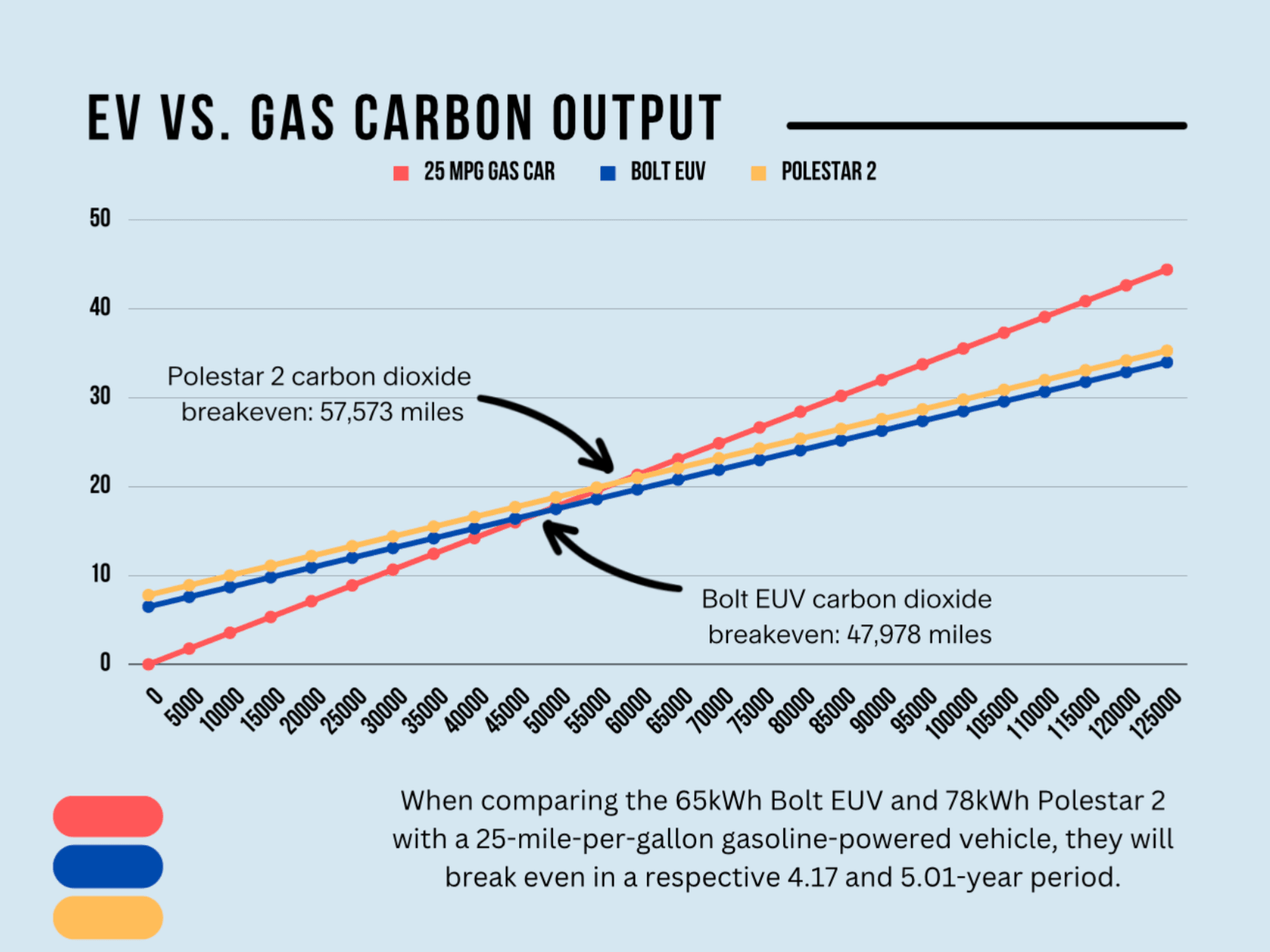
For our baselines, we will take two popular EVs: the 65-kilowatt-hour Chevrolet Bolt EUV and the 78-kilowatt-hour Polestar 2. The Polestar 2’s battery pack will emit 7.8 tons of carbon dioxide in the manufacturing process. The Bolt’s will produce around 6.5 tons of the chemical compound. Electric cars will have a much larger carbon footprint from the get-go than gasoline-powered cars. The chart below shows that a gasoline-powered car will start its life cycle by producing less carbon than an EV. However, it won’t stay that way for long.
Electric Vehicle Total Emissions
The Union of Concerned Scientists has extensively researched the carbon output of electric cars powered from the grid. The group recently reported that an average electric vehicle obtaining its energy in the United States would effectively emit the same amount of carbon dioxide as a 96 mpg gasoline-powered car. Compared to the 25.4 mpg average fuel economy rating of a new gasoline-powered car sold in 2021, it's apparent that EVs pollute less.
But how long will it take to offset its original carbon output from manufacturing its lithium-ion battery pack? We can use the formula below to determine how much an electric car will pollute, using the 96 mpg carbon equivalency and an average mileage of 11,500.
11,500 miles / 96 mpg = 120 "gal. of gasoline"
120 gal. of gasoline * (8.887 * 10^-3) metric tons of CO₂ per gal. = 1.1 metric tons of CO₂
As revealed by the calculations, the Chevrolet Bolt EV's carbon dioxide output will break even with a 25-mile-per-gallon internal combustion engine car by the 47,978-mile mark. This equates to 4.17 years of driving, if the original driver targets 11,500 miles a year. With the Polestar 2's larger, 78 kilowatt-hour battery pack, its break-even period will be greater. Compared to the gasoline-powered car in question, the sleek Polestar requires 57,573 miles or 5.01 years of driving.
A Path To A Cleaner Future
While all these calculations were taken from EVs powered from the aggregate of the American energy grid, it did not consider electric car owners who own home solar. An electric car charged directly from solar means the possibility of zero carbon emissions. While not all owners have access to solar charging, EVs can truly produce zero emissions for driving. It is impossible in an internal combustion engine vehicle, even when using e-fuels at this point in time.
Overall, electric cars are highly efficient pieces of machinery that produce fewer emissions than gasoline-powered cars, even when powered by the grid. However, their production is what makes up a significant portion of their overall carbon emissions. New lithium iron phosphate (LFP) battery technology featured in the Standard Range Ford Mustang Mach-E and entry-level Model 3 and Ys doesn't require rare earth elements like cobalt and nickel. Moreover, utilizing this battery technology is possible without outsourcing labor to other countries.
Without the need for rare earth elements and a global material supply chain, LFP batteries will likely produce a much smaller amount of carbon dioxide upfront. More automakers are opting for this battery technology as it is also cheaper and more durable than the nickel manganese cobalt (NMC) chemistry found in most EV batteries.
Regardless of chemistry, electric car batteries will pay a larger price to the environment at first. But even when charging on the grid, EVs will eventually break even with their internal combustion engine partners. At present, this period is around the four to five-year mark, depending on EV battery size. With a grid shifting towards more renewables and engineers working hard to develop the latest battery technology, this period will likely reduce in the coming years.