Up Next
Model Reviews
2024 Acura ZDX Review: The Ultimate $30k Used Luxury EV Bargain
We review the 2024 Acura ZDX to see if it's a used EV bargain.

Ever
Sep 18, 2026
Read resource

Andrew Lambrecht
Project Engineer
May 8, 2026
The Nissan Leaf needs no introduction. It was the first mass-market EV that hit American shores in late 2010. We’re putting the 40 kWh Leaf S — sold from 2018 through 2025 — through our standard 10 to 80% DC fast charge test to see how this aging platform holds up at the charger.
The Leaf S sits at the entry level of the lineup, packing a 40 kWh battery on a passive air-cooled system. That detail matters, as we’ll see. Nissan rates the car at a peak charge rate of 50 kW via CHAdeMO, with an EPA range of 149 miles. As one of the few remaining vehicles still relying on the CHAdeMO connector, finding compatible fast chargers is becoming increasingly difficult as the standard is phased out in favor of CCS and NACS.
Finding a CHAdeMO station in 2026 is a test in itself. We located an EVgo unit and arrived at the stall with under 10% state of charge on a mild day in the low 60s — about as friendly as ambient conditions get for a passively cooled battery. Unlike many modern EVs, the Leaf S has no battery preconditioning feature, so we resorted to a few acceleration pulls beforehand to warm the battery and lower the electrolyte’s viscosity for better ion flow.
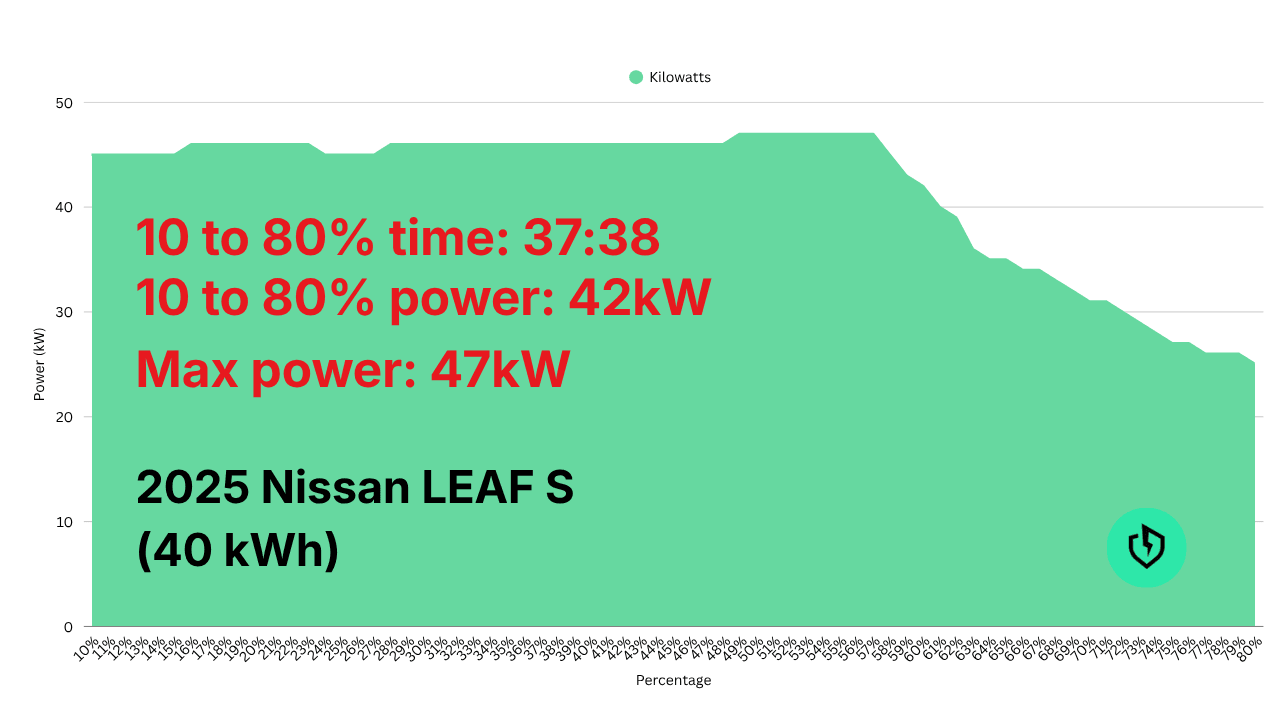
Right from the start, the Leaf pulled a consistent 45 kW, ramping up steadily to its peak of 47 kW by the 16% mark — falling just short of Nissan’s rated 50 kW ceiling. What happened next was genuinely impressive for a car of this age and architecture: it held that 45–47 kW range with remarkable flatness all the way to the mid-50% range. It’s a respectable charging profile, but still anemic compared to modern EVs.
Then came the taper. At 58%, the rate began stepping down — 45 kW, then 43, then 42 — entering a steep and continuous decline. By 65%, we were already down to 35 kW, and the drop only accelerated from there. We crossed the 80% finish line pulling just 25 kW.
The full 10 to 80% session clocked in at 37 minutes and 38 seconds. That’s a slower result than most modern EVs, but it’s also consistent with what you’d expect from a 50 kW peak charger on a 40 kWh pack.
The Leaf S was never built to be a road-trip machine, and the charging data confirms it.
Nissan
About the Author
Andrew Lambrecht
Project Engineer
Andrew Lambrecht is a project engineer at Ever and a leading voice in the electric vehicle sector. An industrial engineer by training and a prolific contributor to outlets like Forbes, Business Insider, InsideEVs, and MSN, Andrew blends technical expertise with sharp insights on EVs, mobility trends, and charging.
Up Next
Model Reviews
We review the 2024 Acura ZDX to see if it's a used EV bargain.
Ever
Sep 18, 2026
Read resource

Watch
Model Reviews
We explore the 2025 Fiat 500e Giorgio Armani Edition to see if it's worth $37,495.
Andrew Lambrecht
Aug 27, 2026
Watch
Model Reviews
We compare the old 2023 Chevrolet Bolt EUV against the updated 2027 Bolt to see charging, range, and tech changes.
Andrew Lambrecht
Aug 25, 2026
Watch
Model Reviews
We put the 2027 Chevrolet Bolt through a real-world 10% to 80% DC fast-charging test at a Tesla Supercharger to validate GM's 25-minute charging claim.
Andrew Lambrecht
Aug 11, 2026
Watch
Model Reviews
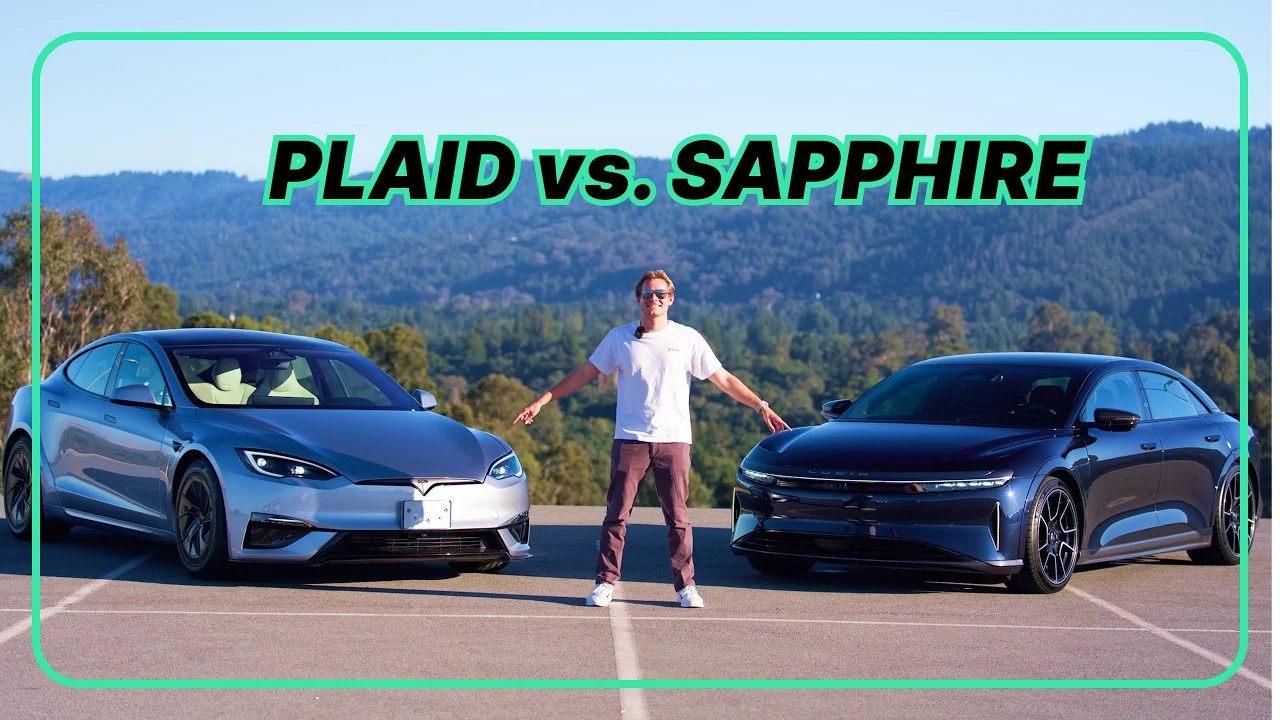
We compare the 1,020-hp Tesla Model S Plaid against the 1,234-hp Lucid Air Sapphire
Andrew Lambrecht
Aug 7, 2026

Watch
Model Reviews
We compare four of the best used EVs under $25,000 in 2026, analyzing the real-world ownership pros and cons of the Model 3, Mach-E, IONIQ 5, and Polestar 2.
Andrew Lambrecht
Jun 30, 2026

Watch
Model Reviews
We break down the updated 2026 Hyundai IONIQ 5. Explore the larger 84kWh battery, trim level standard features, and massive promo price cuts undercutting the Model Y.
Andrew Lambrecht
Jun 22, 2026